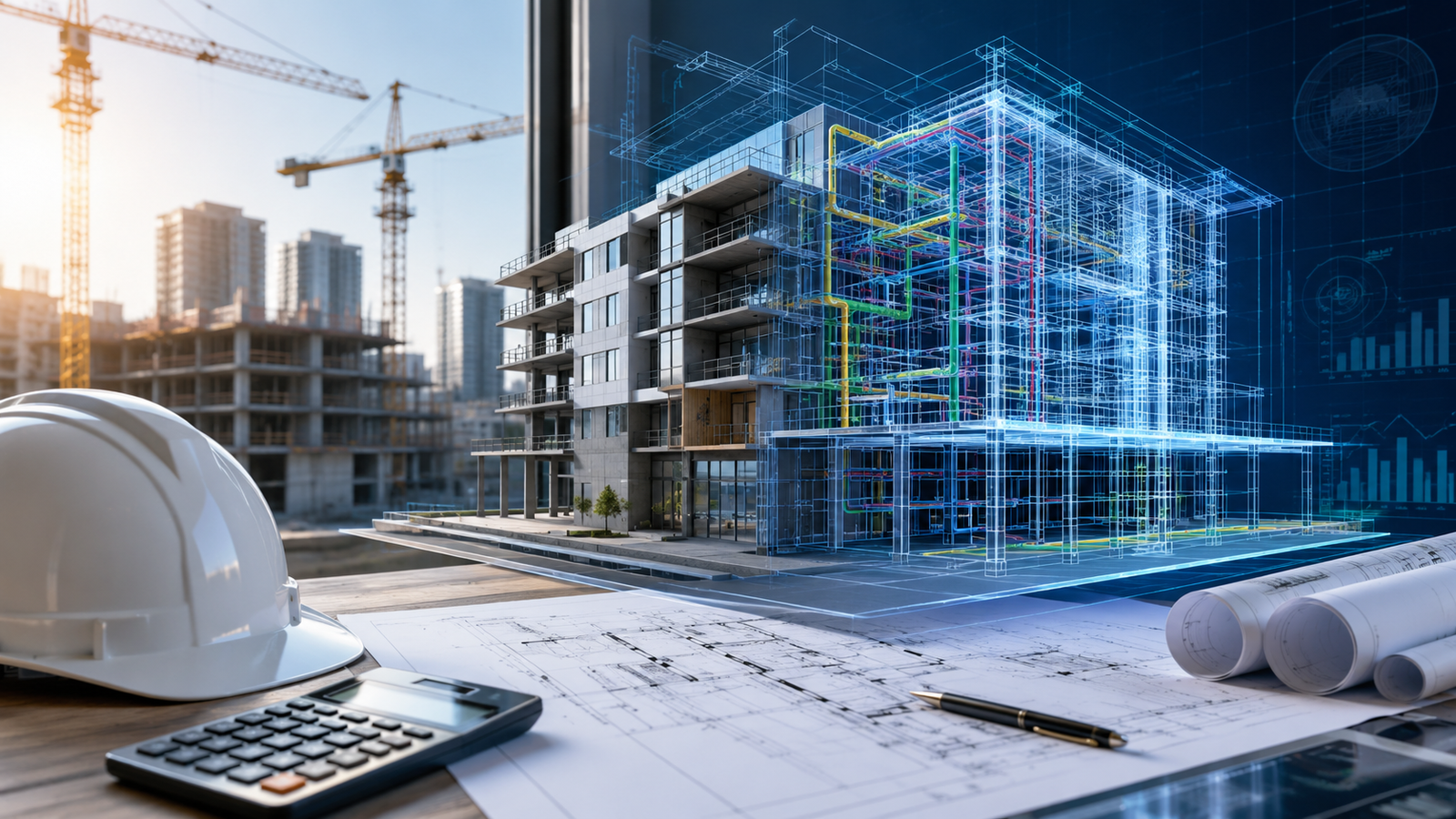
Construction projects rarely go wrong because of one giant mistake. They usually slip because of a long chain of smaller ones. A quantity gets missed. A design revision is not priced fast enough. A procurement order is based on an old drawing. A clash stays hidden until the field team runs into it. That is how a budget starts to drift. McKinsey has long argued that large projects commonly run behind schedule and over budget, which is exactly why teams need better information earlier in the process.
Why does the model change the estimating conversation?
This is where BIM Modeling Services matter. A desirable version is not only a visible device. It is a fact source that turns partitions, slabs, openings, systems, and finishes into measurable objects. Autodesk describes BIM as a holistic manner for creating and coping with statistics approximately a built asset, with based, multidisciplinary records that support decision-making throughout the project lifecycle. Those subjects, because estimates turn out to be an awful lot more dependable, whilst the counts come from a model instead of from manual interpretation by me.
A model also improves coordination. If a duct collides with a beam, the hassle can be determined inside the office in preference to on the website online. Autodesk has time and again talked about how related BIM workflows reduce RFIs and alternate orders by way of catching coordination issues in advance. That is an instantaneous cost gain, not just a design convenience.
What a model-ready scope usually includes
- clear naming for families and assemblies
- measurable geometry, not just visuals
- useful material and finish data
- trade separation, so counts do not blur together
- clean exports that estimators can trust
When those basics are in place, the estimate starts from a much stronger base. That is where the real savings begin.
Reported BIM impacts from recent studies
Reported BIM effect
Result from recent studies
What it means in practice
Design errors reduced
50–60%
Fewer corrections and cleaner pricing
Construction waste reduced
4.3–15.2%
Less over-ordering and disposal loss
Rework costs reduced
40–50%
Lower labor waste
Coordination RFIs reduced
80%
Faster decisions and fewer delays
Change orders reduced
32%
More stable budgets
Unbudgeted changes reduced
37–62%
Less surprise cost movement
These figures come from a recent case study and review literature and should be read as reported study results, not universal averages.
From measured quantities to actual cost
A model gives quantities. It does not yet give a budget. That is where Construction Estimating Service work becomes essential. Estimating is the step that turns quantity into cost by adding labor, equipment, indirect costs, contingency, and real market pricing. Procore defines construction estimating as calculating both direct and indirect project costs, which is why accurate takeoff data matters so much. If the base quantity is wrong, the final number will be wrong too.
A good estimator does more than multiply numbers. They think about access, productivity, staging, weather, procurement timing, and how one trade affects another. Two projects can have the same square footage of drywall and still cost very different amounts to install. One may be wide open. Another may be a cramped retrofit with limited access and tight sequencing. The model gives the facts. The estimator decides how those facts behave in the real world.
Simple calculation: why small waste cuts matter
Suppose a project has a $2,500,000 materials package. If manual quantity handling and over-ordering produce 6% waste, that is $150,000. If BIM-supported takeoff and tighter procurement reduce that to 4%, the waste cost falls to $100,000.
- Traditional waste cost: $150,000
- BIM-supported waste cost: $100,000
- Illustrative savings: $50,000
That is one package. On a larger project, the effect becomes much more meaningful.
Manual vs BIM-linked estimating
Factor
Manual takeoff
BIM-linked estimating
Speed
Slower, especially on revisions
Faster once the model is structured
Human error
More risk of missed counts
Lower risk with clean model data
Revision handling
Old sheets can slip in
Easier to trace and update
Trade coordination
Separate views, more duplication
Shared source of truth
Audit trail
Harder to defend assumptions
Easier to document the scope
Why BIM also reduces delays and rework
Rework is one of the easiest ways for a price range to bleed. A clash that is going unseen in preconstruction can become a website delay, a change order, and a sad customer. BIM enables this because it exposes the conflict early enough to repair it affordably. Recent case-examine work has mentioned decreased RFIs, lower exchange orders, and shorter venture timelines while BIM is used correctly. In the studies reviewed, this translated into quicker coordination and much less late-level remodeling.
These subjects are since time is production money. If the crew can trap a routing issue, a cloth conflict, or a scope overlap earlier than it reaches the sector, the challenge avoids the more extensive efforts, elimination, and reinstallation that commonly follow. That is why BIM and estimating must now not live in separate silos.
Where the project loses money without BIM
Problem found late
What happens on site
Cost effect
Clash between systems
Rerouting, removal, restart
Labor loss + schedule delay
Missing scope item
Emergency ordering
Rush fees + higher risk of error
Wrong quantity
Over-ordering or under-ordering
Waste or downtime
Design change after buyout
Repricing and resubmittals
Change order risk
Where structured reporting matters
Some jobs need more than an internal estimate. Damage repair, restoration, and insurance-driven scopes often need a line-by-line format that can be reviewed by an adjuster or owner. That is where Xactimate Estimating Companies fit naturally. Verisk describes Xactimate as property claims estimating software that is precise, fast, and flexible, with pricing data built from independent market research and regional pricing references. That format is useful when the work must be defended clearly and quickly.
For claims and repair work, this matters because the scope often changes after demo or site discovery. Xactimate makes it easier to present the estimate in a structure that outside reviewers already recognize. BIM gives the team the measured scope. Xactimate gives the estimate a standardized language. Together, they make the process easier to explain and easier to approve.
A practical workflow that contractors can repeat
The best results usually come from a simple, disciplined loop.
- Build the model with estimation in mind, not only presentation in mind.
- Keep naming, units, and attributes consistent from the start.
- Run takeoff early, then again at every major design milestone.
- Price the affected scope before decisions are locked.
- Revisit procurement quantities whenever the model changes.
- Use a structured claims format when outside reviewers need one.
That process may not sound glamorous. It is not supposed to. It is supposed to reduce surprises.
Final thought
BIM and estimating paintings excellent collectively due to the fact they clear up special components of the same trouble. BIM Modeling Services create the measurable base. Construction Estimating Service turns that base into a realistic price range. Xactimate Estimating Companies help when the assignment requires a standardized, evaluation-ready layout for damage or claims paintings. Put the three collectively, and the contractor receives a clearer route from layout to fee, fewer surprises in the discipline, and a better chance of protecting margin.
FAQs
1. How does BIM improve estimating accuracy?
BIM improves accuracy by giving estimators measurable quantities tied directly to the model. That reduces manual counting errors and makes revisions easier to track.
2. Why do estimators still matter if the model gives quantities?
Because quantities are not budgets by themselves. A Construction Estimating Service adds labor, indirect costs, equipment, and market conditions so the number reflects how the work will actually be built.
3. When is Xactimate most useful?
Xactimate is most useful in restoration, damage repair, and claims work where the estimate needs a standardized, auditable format with regional pricing.