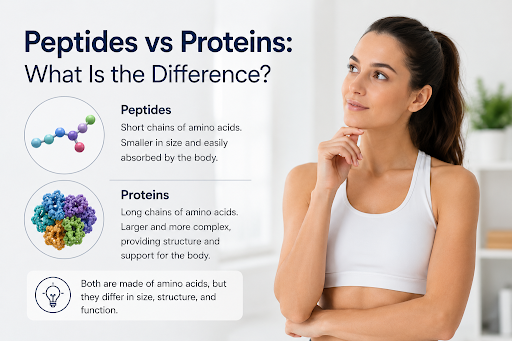
In the world of biochemistry and scientific research, the terms “peptides” and “proteins” are often used in the same conversation — and for good reason. Both are made from the same fundamental building blocks, and both play critical roles in biological systems. However, despite their similarities, peptides and proteins are distinct molecules with different structures, functions, and applications in research. Understanding the difference between the two is essential for anyone looking to explore the science of these remarkable compounds.
The Basics: What They Have in Common
Before diving into the differences, it helps to understand what peptides and proteins share. Both are made up of amino acids — small organic molecules that serve as the building blocks of life. There are 20 standard amino acids that living organisms use to construct these molecules, and the specific sequence of amino acids in a chain determines the structure and function of the resulting compound.
Both peptides and proteins are formed when amino acids join together through chemical links called peptide bonds. A peptide bond forms when the carboxyl group of one amino acid reacts with the amino group of another, releasing a water molecule in the process. This is the same bond whether you are looking at a simple two-amino-acid dipeptide or a complex protein made up of thousands of amino acids.
The Key Difference: Size
The most fundamental difference between peptides and proteins is size. Peptides are short chains of amino acids, typically containing anywhere from 2 to 50 amino acids. Proteins, on the other hand, are much longer chains — generally consisting of 50 or more amino acids, though most functional proteins contain hundreds or even thousands.
This size difference has significant implications for how these molecules behave. Peptides are smaller and generally more flexible, which means they can move more easily through biological systems, cross cell membranes more readily, and interact with specific receptors with great precision. Proteins are larger and more complex, often folding into elaborate three-dimensional structures that are essential to their function.
It is worth noting that the boundary between a peptide and a protein is not always strictly defined. Some scientists use 50 amino acids as the cutoff, while others use different thresholds. What matters most is the functional and structural context of the molecule being discussed.
Structural Complexity
Another major difference between peptides and proteins lies in their structural complexity. Proteins have multiple levels of structure that determine how they function.
The primary structure of a protein is simply the sequence of amino acids in the chain. The secondary structure refers to local patterns of folding within the chain, such as alpha helices and beta sheets, which are held together by hydrogen bonds. The tertiary structure is the overall three-dimensional shape of the protein, formed by interactions between different parts of the amino acid chain. Some proteins also have a quaternary structure, which involves the arrangement of multiple protein subunits working together.
Peptides, being much shorter, generally do not achieve this level of structural complexity. They may have some secondary structure, but they rarely fold into the elaborate three-dimensional shapes that characterize most proteins. This relative simplicity is actually one of the reasons peptides are so useful in research — their structure is easier to analyze and their behavior is more predictable.
Function in the Body
Both peptides and proteins perform essential functions in the body, but they tend to operate in different ways. Proteins serve as the workhorses of the cell — they form structural components like collagen and keratin, act as enzymes that catalyze chemical reactions, transport molecules through the bloodstream, and provide immune defense through antibodies.
Peptides, by contrast, tend to function primarily as signaling molecules. They carry messages between cells and systems, triggering specific biological responses. Insulin, for example, is a peptide hormone that signals cells to absorb glucose from the bloodstream. Endorphins are peptides that signal the brain to reduce pain perception. Growth hormone-releasing peptides signal the pituitary gland to produce and release growth hormone.
This signaling role is what makes peptides particularly interesting to researchers. Because peptides interact with specific receptors to produce targeted biological effects, they can be studied to understand particular biological pathways without affecting the broader system. Suppliers like Core Power Peptides support this kind of targeted research by providing over 100 research-grade peptides at 99%+ purity, all manufactured in the United States and available to researchers worldwide.
Stability and Degradation
One important practical difference between peptides and proteins is their stability. Proteins are generally more stable than peptides due to their complex folded structures, which protect them from degradation. Peptides, being smaller and simpler, can be more susceptible to breakdown by enzymes called proteases, which cut peptide bonds.
This is why proper storage of research peptides is so important. Most synthetic research peptides should be stored in a cool, dry environment — typically in a freezer — and reconstituted only when needed. Core Power Peptides provides guidance on proper storage for all their compounds, helping researchers preserve the integrity of their samples and get the most reliable results from their work. You can find their full catalog and storage recommendations at corepowerpeptides.is.
Peptides and Proteins in Research
Both peptides and proteins are valuable tools in scientific research, but they serve different purposes. Proteins are often studied for their structural and enzymatic roles — researchers might investigate how a specific enzyme catalyzes a reaction or how a structural protein contributes to cell integrity. Peptides, on the other hand, are frequently studied for their signaling and regulatory functions.
Research peptides like BPC-157, TB-500, CJC-1295, Ipamorelin, and many others available through Core Power Peptides allow scientists to investigate specific biological pathways with a level of precision that would be difficult to achieve with larger, more complex proteins. This targeted approach makes peptide research an especially powerful tool for advancing scientific understanding.
Therapeutic Applications
The difference in size and function between peptides and proteins also has implications for their potential therapeutic applications. Peptide-based drugs have become an increasingly important area of pharmaceutical research, with compounds like insulin, semaglutide, and various other peptide hormones already approved for medical use.
Compared to protein-based biologics, peptide drugs are generally easier and less expensive to synthesize, more stable under certain conditions, and capable of highly targeted action. These advantages have made peptide drug development one of the fastest-growing areas in modern medicine. Research into synthetic peptides, supported by high-quality compounds from suppliers like Core Power Peptides, is helping to lay the groundwork for the next generation of peptide-based therapies.
Final Thoughts
While peptides and proteins share the same chemical foundation, they are distinct molecules with different sizes, structures, and functions. Peptides are smaller, simpler, and primarily serve as signaling molecules, while proteins are larger, more complex, and perform a wider variety of structural and functional roles.
For researchers working in the field of peptide science, understanding this distinction is fundamental. And when it comes to sourcing the high-quality research peptides needed to conduct meaningful work, Core Power Peptides stands out as a trusted USA-based supplier offering 100+ compounds at 99%+ HPLC-verified purity, shipped worldwide to support the global scientific community.